The Science and Engineering team at the Child Mind Institute is dedicated to transforming the lives of children with mental health and learning disorders through the power of scientific discovery.
Blog
Governor Kathy Hochul Visits Healthy Brain Network Harlem Facility
May 8, 2024
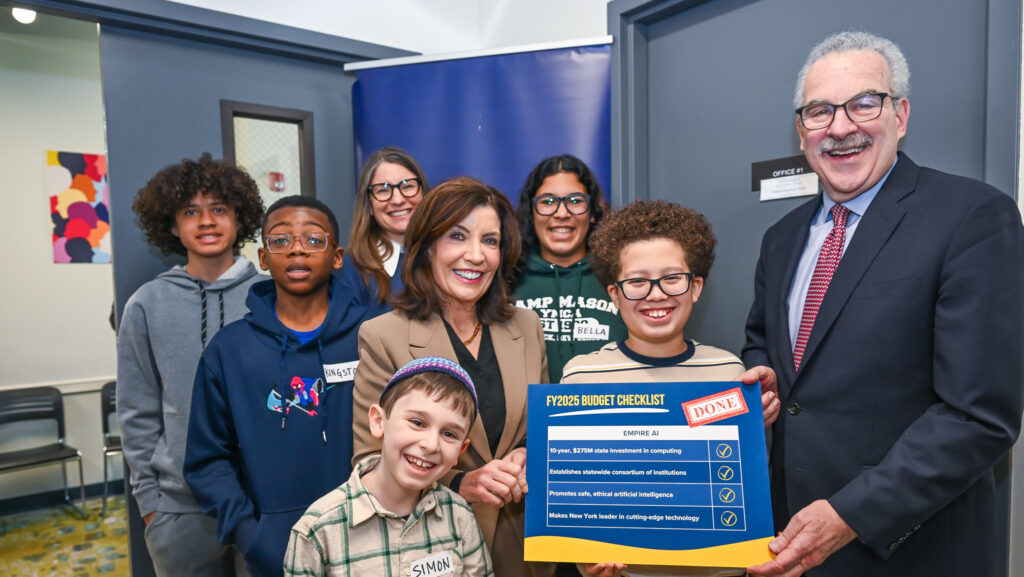
On Monday, April 22, New York State Governor Kathy Hochul visited the Child Mind Institute Healthy Brain Network Harlem office. Her visit celebrated policy achievements of the FY25 Enacted Budget, including a 10-year, $275 million investment to establish Empire AI, a one-of-a-kind partnership of public and private universities across the state to facilitate the innovation, research, and development of AI technologies.
Too often, the computing resources that power AI systems are out of reach for researchers, public organizations, and small businesses, giving large tech companies the upper hand when it comes to the development of AI. The Empire AI consortium will create and launch a state-of-the-art computing center on the University at Buffalo’s campus for use by New York’s leading institutions.
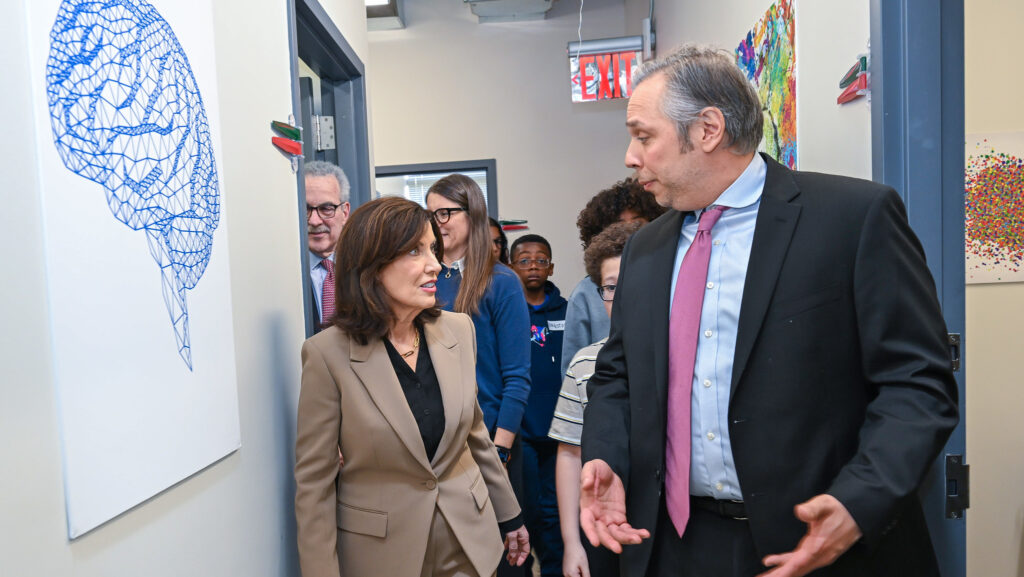
On her visit, Governor Hochul toured the evaluation center and met with study participants and their families, as well as Healthy Brain Network staff. She also met with Child Mind Institute Chief Science Officer, Michael Milham, MD, PhD, and Child Mind Institute President, Harold S. Koplewicz, MD, about partnering to advance AI in mental health research and clinical care. When asked how Empire AI could support science and research efforts at the Child Mind Institute, like the Healthy Brain Network, Dr. Milham said:
“We are truly excited about the Governor’s commitment to AI. The Child Mind Institute is dedicated to changing the trajectory of mental health outcomes for individuals everywhere through the advancement of early detection, intervention, and prevention. Central to our mission is the innovation and scaling of mental health care and research through neuroscientific discovery, open science, and applied digital technologies.
The Governor’s initiative and its infrastructure will allow researchers to harness the power of AI and rich datasets obtained using technologies like MRI, EEG, eye tracking, and smartphones to accelerate neuroscientific discovery for brain and behavior. This will allow our field to realize its vision of finding reliable measures of brain and behavior upon which clinical tools for mental health can be developed. Equally important, we expect that these methods will increase the efficiency and scale with which mental health research and care can be delivered to children and families everywhere.”
– Michael Milham, MD, PhD
Frequently Asked Questions
There has never been a more important time to use technology to improve access to care.
That’s why we’re working on tech that helps clinicians improve communication with their patients and better understand what is happening between appointments. And all of our innovations are open-source and free to use.
he Healthy Brain Network is a landmark mental health study to help children in New York City and worldwide. Each participating child receives a diagnostic evaluation at no cost. Educators, clinicians and service providers can partner with us to connect families.
Our team of researchers and engineers brings together expertise across a diverse range of disciplines, enabling the kind of innovative collaborations that speed the pace of discovery.
Tagged with:
In The News, Science and Research, AI Research
Marijayne Bushey
Mj Bushey is a research marketing specialist at the Child Mind Institute. Her outreach efforts inform families that participation can … Read Bio